
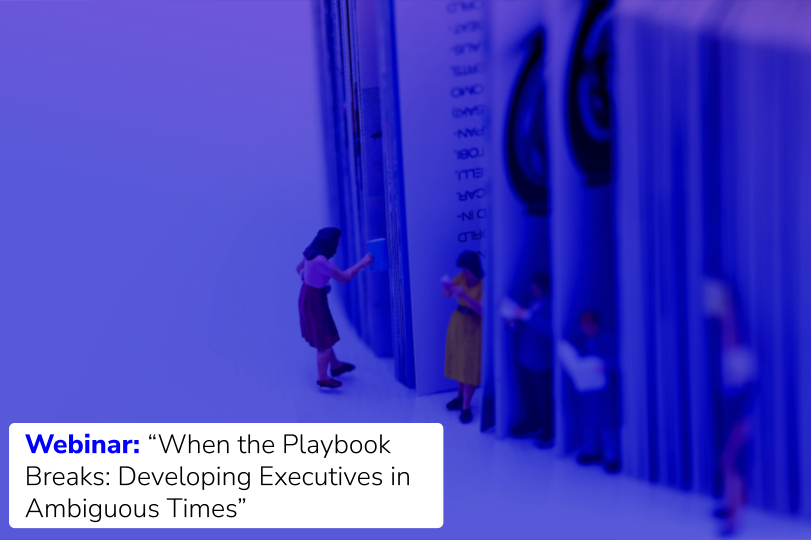
The Challenge Executives Face
Complexity is accelerating. The pace of change executives experience today is the slowest it will ever be again—a sobering reality that’s driving unprecedented uncertainty even among the most talented leaders. In a recent webinar with Hudson Institute, PwC Canada’s Partner Experience Leader Karin Muchall and Hudson VP of Coaching and Advisory Trudi McCanna explored why so many executives feel unprepared, despite their track records of success.
The culprits? A relentless pace of change, the always-on culture of modern business, and an outdated approach to leadership that no longer works.
Three Key Takeaways
1. The Expert Model is Dead—Adaptability is the New Currency
Gone are the days when executives could succeed by being the smartest person in the room. Leaders today must shift from being subject matter experts to facilitators who bring diverse perspectives together, make decisions with incomplete information, and stay comfortable with pivoting as new data emerges. It’s less about having all the answers and more about knowing how to navigate uncertainty.
2. Always-On Culture Creates Hidden Costs
Twenty-four-seven connectivity may feel productive, but it’s eroding executive resilience. When leaders can’t truly disconnect, they lose the downtime essential for strategic thinking and well-being. Organizations that ignore this are missing a critical opportunity to support their people—and their bottom line.
3. Effective Development Requires Business Partnership
The most successful executive development programs don’t start with a curriculum—they start with a business problem. Rather than rolling out one-size-fits-all learning initiatives, effective programs align directly with organizational pain points and require patience to implement. It takes 3-4 years of experimentation, measurement, and refinement to build lasting impact.
What This Means for Organizations
If your organization wants to support executives through this turbulent period, start small. Identify your biggest business challenge, then ask: How might we use a developmental approach to solve this? You don’t need to launch a complete executive development program overnight. Pilot initiatives in high-impact areas, measure the results, and build from there.
The executives you’re trying to support are already stretched thin. The question isn’t whether to invest in their development—it’s how to do it in a way that actually moves the needle on business outcomes.
Watch the Full Webinar for deeper insights on building resilient executive teams, creating psychological safety in high-pressure environments, and designing development programs that stick. Hear directly from Karin Muchall and Trudi McCanna as they share their strategies for supporting leaders in an age of accelerating change.
![[Video] Authors in the Field Ft. Henry Evans](https://hudsoninstitute.com/wp-content/uploads/2026/09/Authors-in-the-Field-blog-post-thumbnail_Henry_Evans.png)
![[Video] Authors in the Field Ft. Dr. Summer Allen](https://hudsoninstitute.com/wp-content/uploads/2026/08/Authors-in-the-Field-blog-post-thumbnail_Summer-Allen.png)