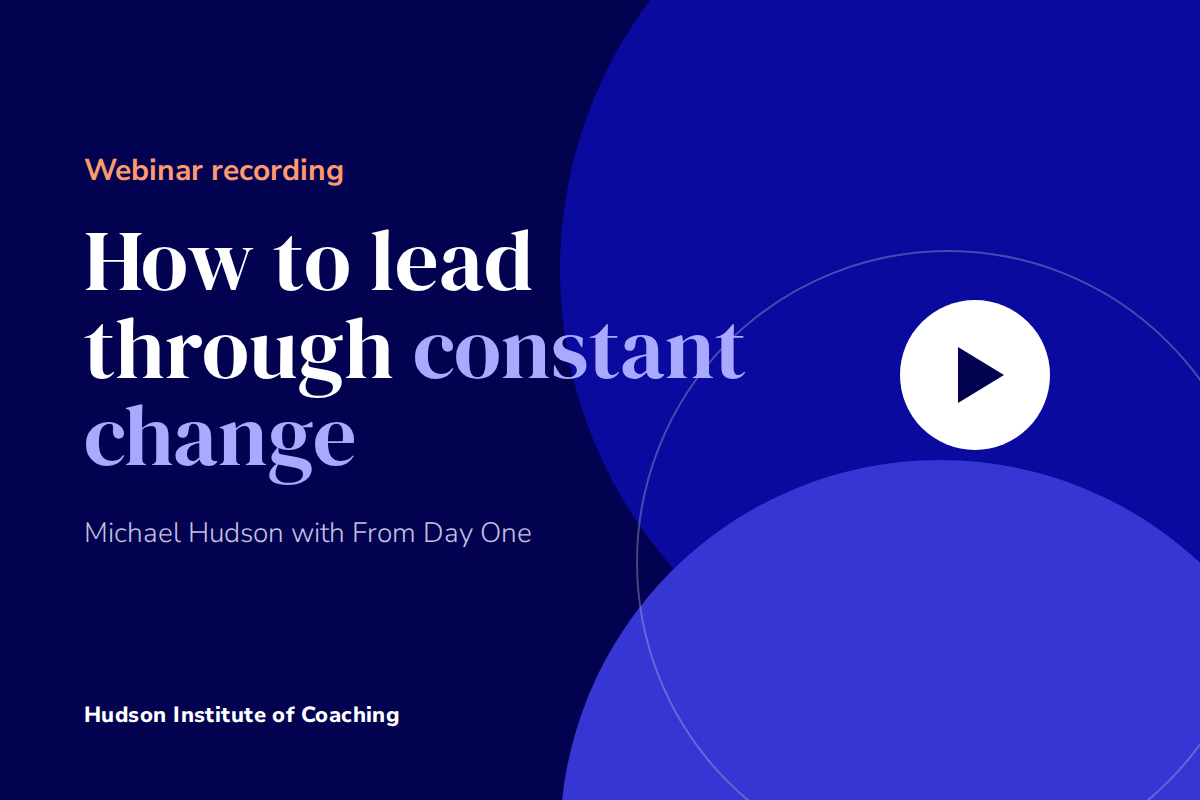
Recorded with From Day One. Michael Hudson of Hudson Institute of Coaching, in conversation with journalist Emily McCrary-Ruiz-Esparza.
Most of us still treat change like something to wait out. Something happens, we make a plan, and things settle down. For a lot of leaders right now, things aren’t settling down.
That was the starting point for How Coaching Builds Change Fitness in Leaders and Organizations, a From Day One webinar with Michael Hudson. Watch the full conversation above, or read on for the ideas we’re still thinking about.
How do leaders handle change that never settles?
Leaders handle constant change by learning to work with it instead of trying to control it. Hudson calls this capacity change fitness. The idea starts from a simple premise: change is no longer an event that ends. It’s more like the weather, always around us and always shifting.
Michael shared a moment from a walk with a mentor. He heard himself say he couldn’t wait for things to go back to normal. She stopped him right there: things are not going back to normal. When we treat change as an event, we try to control it. When we accept that it’s ongoing, a better question opens up: what can we do with it? Michael’s answer is to work with change, and turn the disruption into learning, growth, and new ideas.
Why do change initiatives fail?
Most change initiatives fail because they map the technical steps and skip the people living through them. The familiar playbook goes like this: see the change coming, build a plan, execute it, get back to work. The plan often looks like a Gantt chart.
A plan can be smart and still fail if people aren’t brought along. Michael pointed to AI adoption as an example. Organizations set a usage target, while employees quietly wonder whether the tool is meant to replace them. Those unspoken stories drive behavior, even though no one can see them.
He’s been there himself. Early in his career, he brought KPIs and a dashboard to a struggling team. Two weeks later, progress had stalled. The team had read the dashboard as surveillance. The plan wasn’t wrong. He just hadn’t asked how they would see it.
What do leaders need to lead through uncertainty?
Leaders need three capacities to lead through uncertainty: contain, connect, and conduct. Together, they make up what Hudson calls change fitness. Michael calls them capacities rather than skills because they’re less like a tool you pick up and more like fitness you build over time.
Contain
Stay with people’s reactions without rushing to fix them. When feelings get skipped, fears go underground and quietly drive behavior.
Try asking: what’s coming up for you right now?
Connect
Make sense of what’s happening together. Everyone on your team reads the situation a little differently, and asking how they see it gives you a fuller picture than any one view can.
Conduct
Move forward without certainty. You won’t get clarity, but you can still act with confidence: try something, learn from it, adjust. Think compass, not map.
“The whole point of Contain is that the feelings are the work.” Michael Hudson
How can leaders get better at adapting to change?
Leaders get better at adapting to change through their own development, not through more training. If these were skills, a framework and a checklist would be enough. They aren’t, because each one pushes against habits we’ve carried for years.
Michael described a client who struggled to give feedback. He already knew the models. What held him back was that he saw himself as a kind person, and giving feedback felt unkind. No feedback model was going to fix that. Working through that belief did.
That’s what developmental coaching does. Hudson coaches help leaders see the stories behind how they react, so they can choose a different response when it matters most.
How can a leadership team navigate change together?
A leadership team navigates change best when everyone builds these capacities together. One leader working this way helps. A team that shares a language for change can shift the culture around it. Michael described coaching leaders as a cohort, then bringing them together to talk about the experience itself.
The timing may be on your side. As Michael put it, most leadership teams can already feel that something isn’t working, and that makes it a good moment to try something new.
Questions from the webinar audience
How can leaders show vulnerability in a fear-based culture?
Start small. Michael suggested a “minimum effective dose” of vulnerability. You may not shift the whole system, but a little openness can shift your team.
What’s missing from traditional change management models?
The human side. Existing models handle the technical steps of change well, but they underestimate how people feel about the change and how those feelings drive behavior.
How do you make sense of change with a large group?
Break into smaller groups and feed the insights back up. Michael pictures it working best at 10 to 20 people. The one thing it can’t be is a solo act.
Are some industries better at handling change?
Industries have different defaults, but the failure modes are human, not industry-specific. Every leader runs into them, and every leader can develop around them.
How does Hudson help leaders navigate change?
Hudson helps organizations build their leaders’ change fitness through developmental coaching, coach-led experiential learning, and everyday development. We’d be glad to hear what your leaders are working through.
![[Video] Authors in the Field Ft. Henry Evans](https://hudsoninstitute.com/wp-content/uploads/2026/09/Authors-in-the-Field-blog-post-thumbnail_Henry_Evans.png)
![[Video] Authors in the Field Ft. Dr. Summer Allen](https://hudsoninstitute.com/wp-content/uploads/2026/08/Authors-in-the-Field-blog-post-thumbnail_Summer-Allen.png)