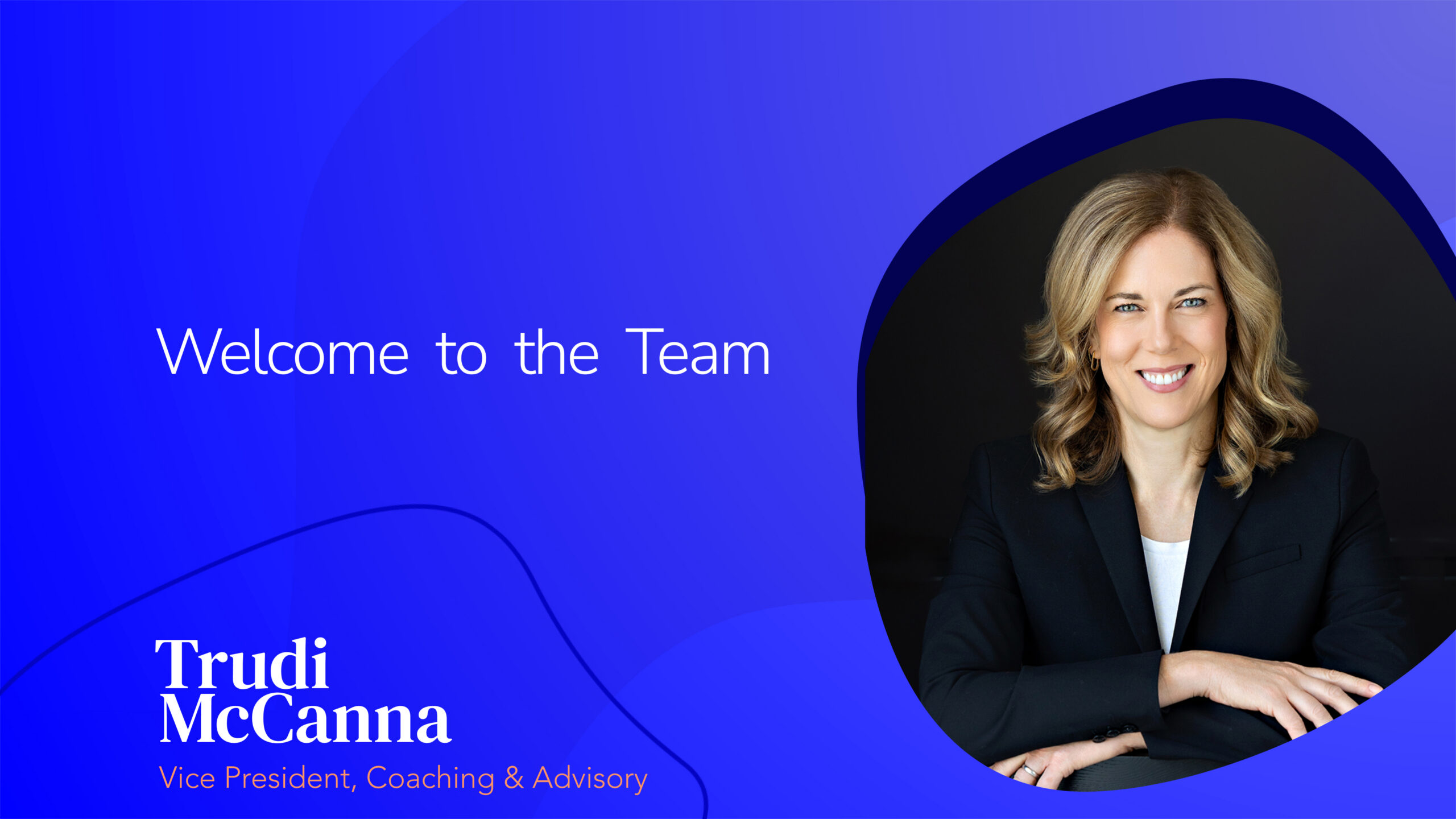
Welcome to Hudson: A Conversation with Trudi McCanna, VP of Coaching & Advisory
Trudi McCanna joins Hudson as VP of Coaching & Advisory, bringing experience leading leadership development at companies such as Google and JetBlue Airways. She sat down with the Marketing team to talk about what’s making leadership so hard right now, what “development” really means, and what she’s most excited about in her new role.
You’ve spent much of your career helping leaders grow in complex environments. What are you seeing leaders struggle with most right now?
Leading is hard right now — harder than at any other point in my career. One of the biggest shifts I’m seeing is that, with AI, leaders are less and less responsible for one distinct functional area where they hold all the expertise and answers. Instead, they’re having to work laterally across the organization more than ever before, and they’re doing it amid a huge amount of uncertainty about where things are headed.
I’ve coached leaders in the tech space, and even many of those who lead AI say they are genuinely curious about what’s going to happen next — and they’re the ones building it even in the midst of so much that’s unknown. That combination of complexity and not knowing the destination is a real departure from ten — or even five! — years ago. Early in my career, I used to facilitate 10- and 20-year strategic planning workshops. During my years in high tech, we could barely see past the next quarter. Now it’s even shorter than that.
Can you say more about the mechanics of that — what does operating more cross-functionally actually look like day to day?
Executive teams I work with are coming together in ways they didn’t used to have to, because they can’t make good decisions and drive progress independently anymore — there’s too much integration required across the business. It used to be that each leader owned a functional domain or vertical area and was the expert in that lane. Now the C-suite is asking a bigger, different question that no single function can answer alone. They have to come together to answer it. On top of that, AI tools can now generate plans for a functional problem that are sometimes nearly as good as what a leader or single team working alone might come up with — so the real differentiator becomes how humans navigate complexity together, and that’s a different skill than what leaders have traditionally been asked to build.
What does “leadership capacity” mean to you, and why does it matter?
I’ve watched leaders in very similar roles and environments — some thrive, and some don’t. Most of the difference isn’t in their skill set or their past experience. It’s in how they think about their role and their work. Some leaders get spun up, tired, stressed and fall into defensive patterns like micromanagement; others right next to them hold a mindset that’s more expansive and resilient.
I think of capacity as a function of the mental models leaders build to navigate the moment they’re in. There’s real research on adult development showing there are defined stages that shape how we make meaning of what’s happening around us — and the further we move through those stages, the more complexity we’re able to hold. For instance, take a new college student. It’s common for young adults in that stage to see the world in fairly binary terms: things are good or bad, the professor is amazing or the worst. As people move through these developmental stages, the world becomes less binary and more about holding paradox and tension rather than treating everything as a problem to be resolved.
Capacity, to me, is about how well leaders have developed that meaning-making system — whether they can meet what the moment is asking of them, or whether the moment crushes them because they can’t hold its complexity.
How would you define development?
Development is the evolution of those meaning-making systems — the process by which we become able to integrate a broader range of perspectives and make sense of the world with greater nuance and complexity. This supports us not just to survive the moment we’re in, but to thrive in it and show up the way our teams, organizations, families and communities need us to. And part of what makes this moment hard is that it isn’t about getting it “right.” I was a straight-A student, and a lot of the leaders I work with were too. But leading right now isn’t about earning an A — it’s about how well you hold everything that’s in tension at once.
What does it actually take for someone to develop?
A few things, based on both the research and what I’ve seen. First, development typically doesn’t happen without reflection. You can go through a hard experience and just move on, or you can pause and ask: what am I learning, how am I changing, what’s being called for now and next? That reflection is actually what creates development.
Second, for adults, there can be real value in being with other adults — hearing how other people make meaning, and how they challenge their own thinking, helps you evolve your own. And third, some of it is simply time and experience. There’s no shortcut around that.
How can someone be a hugely accomplished, successful leader and still not have reached a more advanced stage of development?
A story that stays with me: I used to work at JetBlue Airways, coaching people across the organization, including flight mechanics — I love working with these leaders because they were true experts who took their responsibility around ensuring the safety of thousands of passengers very seriously. I was coaching one mechanic who’d been promoted into a more senior role. He told me, “I’m the best flight mechanic and supervisor out there — I know I am. But now I’m responsible for hundreds of airplanes, rather than one shift’s worth, and I don’t know how to do that.” He was used to being the hands-on expert who could simply outwork any problem. But there are no more hours to add. He couldn’t figure out how to let go of that identity and think about his value differently.
I see a version of this often with clients who move from leading one function or site into a role in which the scope of their responsibility is an order of magnitude larger than it was before. It’s disorienting, because your whole sense of what value you add — of contribution itself — has to change. You’re no longer the one making the fast, hands-on calls, and that’s a completely different way of relating to your own work.
What did you learn about developing leaders in fast-changing environments during your time at Google?
That there’s no single right answer. Google is really many systems within one big system, and what a leader needs can differ significantly depending on where they sit and when. Just-in-time, individualized support matters a lot.
I also learned that leadership development isn’t only valuable for the individual — it can build social infrastructure across a company that’s just as important as one-on-one work. A lot of what I did at Google during my time leading executive development was bringing groups of leaders together at key moments. When people reflect together on their development, it builds a different kind of relationship than, say, an offsite focused on product roadmaps. I had leaders tell me they were able to get major things done because of relationships built years earlier in a development program — people they knew they could call on, or who showed up to help them move really big and tricky things forward.
There’s individual development, and then there’s collective development that creates connective tissue across a company — and that happens through doing the real work of development together, more so than through meetings, conferences or offsites.
What separates organizations that successfully build leadership capacity from those that struggle?
I used to answer this question by saying “a CEO who personally champions development.” More recently, I’ve formed a new perspective, which is that every CEO is in reality already a sponsor of leadership development — who doesn’t want a significantly stronger bench? But often, the CEO doesn’t speak the language of development, so development programs don’t get aligned with what’s most important. As a field, we sometimes get excited about what’s worked elsewhere, or what the research says should work, without first understanding what’s actually important to the business leaders we’re trying to reach. When we take the time to understand that — in their own terms, not ours — coaching and development work can have an enormous impact.
One thing I like to do is find out what a CEO reads. Most read a lot, and they tend to gravitate toward authors and frameworks that resonate with how they think. Asking what’s stood out to them lately is often one of the best signals I get for how to talk about development in a way that will actually land.
Has the way you approach that changed for you over time?
Yes. I push less than I used to. Earlier in my career, I’d get excited about a framework or approach and try to drive it forward on my own. I’ve learned that no matter how well-designed the process, if you’re not first in alignment with the people who need to own it, it doesn’t stick. That doesn’t mean giving up on what I think is right — it means knowing that I can’t do it alone and have to align and come together with others for an approach to have meaning and some staying power.
Coaching has traditionally been reserved for a relatively small number of senior leaders. Do you see that changing?
Definitely. Coaching used to be something you got if you were a senior leader with a “problem.” Then it evolved into support for senior leaders in important roles who needed help with meaning-making and the demands of the job. Now I’m hearing from far more people who want coaching, at every level, because so many of us are trying to bring more ease to our lives amid everything going on. Companies see coaching as a genuinely useful tool now too, and are actively looking for ways to bring it to more people.
Why do you think companies find it useful?
I can speak to what I’ve seen directly: some of my favorite clients are senior leaders who are overworked, unhappy, and struggling after a recent promotion — and six months later, they’re excited about the job, they’ve figured some things out, they’re performing better in their organization as a result. The people around them notice. There’s also been enough research, alongside enough lived experience, that companies now see the impact of coaching as real and meaningful, not just a nice-to-have.
What excites you most about the work Hudson is doing with organizations right now?
Honestly, so much. The world needs Hudson badly right now. Everyone is trying to figure out this meaning-making, development work, and it’s genuinely hard to be human inside these systems. At Hudson, we help pull people out of those systems just long enough that they can do the work needed, and then go back in with a different mindset. It’s really remarkable to see what becomes possible when it happens.
More specifically, I’m excited about the work we’re doing to bring Hudson-level, Hudson-quality coaching to much larger VP and director populations. Those levels have sometimes had access to coaching, but rarely at scale — and in my experience, that’s exactly where the complexity of today’s world is landing hardest. I feel strongly that coaching needs to show up for the leaders doing that work right now, because those levels are under enormous strain. We’re not a huge coaching shop, and we hold a clear stance and standard for how we believe coaching should work and the role it can play — so figuring out how Hudson brings more of that coaching to this population is something I’m genuinely excited about.
I’m also excited about how we give more of the world a taste of Hudson — connecting more Hudson graduates with the coaching work that’s needed out there. And I’m excited about Michael Hudson’s thought leadership on change fitness, which helps leaders understand more about what to do during these times. His framework is so needed right now — it gives leaders some anchors for a role that’s become genuinely hard to define. My dad was a senior manager for decades in aerospace, and his job description was always very clear. Right now, it’s really hard to say what the job of “leader” even is. Change Fitness sets the course in defining it. I’m also excited about the re-release of Self as Coach and the work Pam McLean is doing — it’s really a roadmap for development: how do I reflect on myself and figure out where change is most needed, so I can make my fullest contribution?
As you step into this advisory-focused role, what are you most looking forward to helping clients accomplish?
I think about the people who lead HR functions — CHROs, HRBPs, CLOs, heads of talent, heads of coaching. Everyone in those roles is trying to understand what leaders need right now and how their function can help meet the moment. I hope Hudson can do two things for them. First, be a true thought partner, so they’re not figuring this out alone. Second, provide connective tissue across those functions and across companies, so that collectively, we’re working out some of these answers together, too.
Hudson has 40 years of experience in developing leaders and understanding adult development. That’s exactly what these functions are trying to figure out right now — how to help leaders build the mindsets, capacity, resilience, and ability to engage with this moment in ways they haven’t had to before. I hope we can be a genuine resource and partner to organizations as they find new ways to do that.
 Written by Parisa Ahmed, Hudson Marketing Team
![[Video] Authors in the Field Ft. Henry Evans](https://hudsoninstitute.com/wp-content/uploads/2026/09/Authors-in-the-Field-blog-post-thumbnail_Henry_Evans.png)
![[Video] Authors in the Field Ft. Dr. Summer Allen](https://hudsoninstitute.com/wp-content/uploads/2026/08/Authors-in-the-Field-blog-post-thumbnail_Summer-Allen.png)
![[Video] Navigating Complexity: How to Support Today’s Executive Leaders](https://hudsoninstitute.com/wp-content/uploads/2026/06/Webinar-Video-Thumbnail_Executives-e1782420868210.png)