
Finding your footing after a layoff
By Pam McLean, PhD, co-founder of Hudson Institute of Coaching and author of lifeFORWARD: Charting the Journey Ahead. Originally published May 2020; updated October 2026.
A colleague called me recently, just days after learning that her position had been eliminated. She was stunned, angry, and uncertain about what to do next. I listened for a while, then found myself doing what so many of us do when someone we care about is struggling. I began offering advice.
After we hung up, I realized I had really missed the mark. She wasn’t looking for my advice. She was in shock and just trying to absorb what had happened.
What should you do first after losing a job?
When we are victims of a layoff, our first instinct is often to take action and make a plan. And when our work has been central to our identity (and essential for paying the mortgage!), the urgency can feel overwhelming. Yet sometimes the first task is simply to take in what’s happened, including the anger, disappointment, and sense of loss that may accompany it.
What is the Cycle of Renewal?
For more than forty years at Hudson, we’ve been studying the ways adults navigate change. One of the things we’ve learned is that our lives don’t unfold in the steady trajectory we might have imagined when we were younger. We settle into chapters that work for us, sometimes for many years, and then something shifts. Occasionally we initiate the change. Other times, as with a layoff, the decision is made for us.
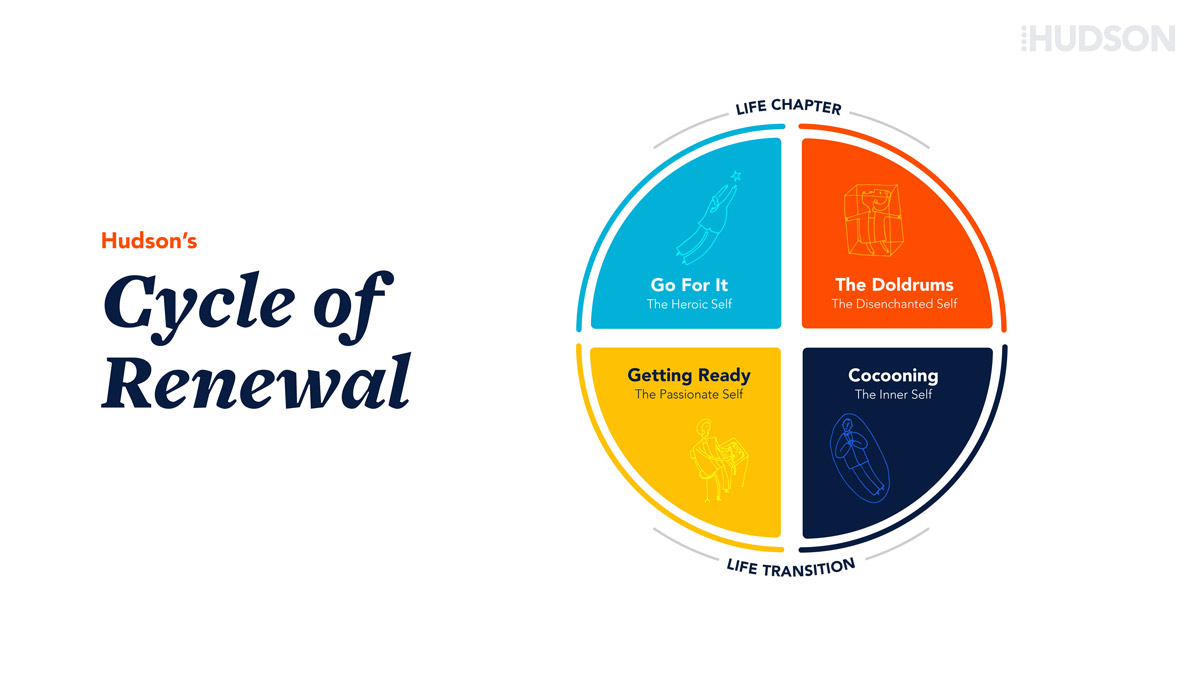
Our Cycle of Renewal describes these recurring patterns of adult life, including the often uncomfortable period between an ending and a new beginning. It’s a time when familiar routines have disappeared, our sense of identity may be shaken, and the future is anything but clear. Most of us would prefer to skip this part!
Why does the in-between time matter after a layoff?
I’ve come to see how essential these in-between periods, these liminal spaces, are. Something begins to shift when we put reflection before action, when we get on the balcony and assess where we’ve been and what we’ve learned. What did I love about my work? What had I quietly grown tired of? What have I learned about myself in this last chapter? And perhaps most interesting, if I weren’t so intent on replacing the job I just lost, what else might I consider?
What if you need to find work quickly?
Of course, these questions don’t pay the mortgage. Some people need to find work quickly, and there’s no getting around that reality. But even when the pressure is on, finding a little time to look beyond the immediate job search can make a difference.
I’ve watched people rush into the next available role, relieved to have the uncertainty behind them, only to discover months later that they’ve recreated much of what was no longer working. I’ve also watched people use an unexpected ending to reconsider long-held assumptions about success, the kind of work they enjoy, and how they want to spend their time.
How can you get through the transition?
If you’re in the midst of such a transition, find a couple of simple ways to keep some structure in your days. Get outside. Spend time with people who know you well. Try small experiments. Pay attention to what sparks your curiosity. And, when possible, resist the pressure to turn every waking hour into a job search.
You may discover that what you want next is quite different from what you wanted ten years ago. That, too, is part of growing and changing throughout our adult lives.
How Hudson can help
At Hudson, we’ve designed our transition programs around this understanding of adult development. We bring people together to make sense of the chapter that’s ending, explore possibilities they may not have considered, and begin making thoughtful choices about what comes next. There is room for uncertainty, for new ideas, and eventually for the practical work of building a plan. We’ve learned over the years that all three matter.
If you’d like company in this work: our free guide, When change is decided for you, offers a gentle place to start.
On December 2, Keith Naber and I will host a free webinar, Laid Off, Restructured, or Stuck? Finding Your Footing.
Frequently asked questions
Yes. Shock, anger, betrayal, grief, and relief are all common, and they often shift from one hour to the next. In a 2026 survey of 1,000 laid-off workers, 41% said they felt blindsided and 49% felt anxious or fearful about the future (Resume Genius, 2026).
The job market has tightened. Nearly half of Americans (48%) are very concerned that people who want to work can’t find jobs, the highest level Pew Research Center has recorded since 2021 (Pew Research Center, 2026). Workers put their chances of finding a new job within three months of losing one at 46% (Federal Reserve Bank of New York, 2026). The emotional toll is real too: a review of more than 300 studies found psychological distress is roughly twice as common among people out of work (Paul & Moser, 2009), and a more recent analysis confirmed mental health is the part of our health most affected by unemployment (Picchio & Ubaldi, 2023).
It varies, but longer than it used to. In September 2026, 1.9 million Americans, more than a quarter of the unemployed, had been looking for six months or more, and 4.5 million were working part-time because they couldn’t find full-time work (U.S. Bureau of Labor Statistics, 2026). Of those who find new work after a layoff, 65% take a pay cut (Resume Genius, 2026).
If your finances allow, take a short, intentional pause first to take in what happened and reflect. If they don’t, you can search and reflect at the same time: keep a little structure in your days and set aside some time each week to think about what you want next.
The evidence suggests it does. In one study by economists at the New York Fed and MIT, referred candidates made up about 6% of applications but more than a quarter of hires (Government Executive, 2014). The most useful conversations ask for information and advice, not a job.
LifeForward is Hudson Institute of Coaching’s five-day program built on the Cycle of Renewal. In a small, confidential group with an experienced coach, participants make sense of the chapter that ended, explore new possibilities, and leave with a plan for the next one. It’s offered in person and live online.
References
- Bureau of Labor Statistics. (2026, October 2). The Employment Situation: September 2026. bls.gov
- Federal Reserve Bank of New York. (2026, October 7). Survey of Consumer Expectations, September 2026. newyorkfed.org
- Paul, K. I., & Moser, K. (2009). Unemployment impairs mental health: Meta-analyses. Journal of Vocational Behavior, 74, 264–282. doi.org/10.1016/j.jvb.2009.01.001
- Pew Research Center. (2026, October 8). Cost Concerns Dominate as Public’s Economic Ratings Turn More Negative. pewresearch.org
- Picchio, M., & Ubaldi, M. (2023). Unemployment and health: A meta-analysis. Journal of Economic Surveys. doi.org/10.1111/joes.12588
- Resume Genius. (2026, September 4). 2026 Human Impact of Layoffs Report. resumegenius.com
- Federal Reserve Bank of New York and MIT study on employee referrals, as reported by Government Executive (2014, December).