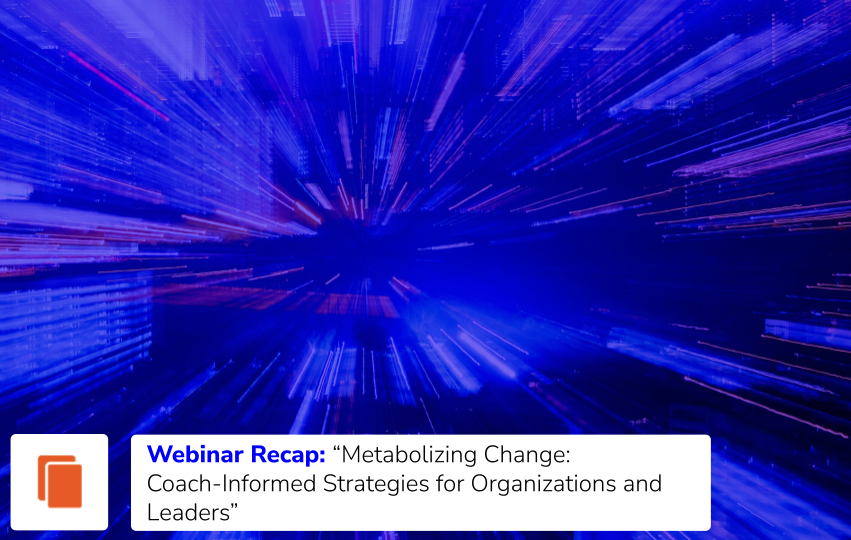
Click here to watch the full webinar.
“I don’t know what to teach leaders right now; things are just changing too fast.” That’s what the Chief Learning Officer at one of the world’s biggest tech firms said to me recently—and it echoes what I hear everywhere. The old playbook for leadership development was built for a world where change had a beginning, middle, and end. That world doesn’t exist anymore.
Hudson has been in organizational coaching for two and a half decades. We often work in a developmental capacity, but increasingly, our work is about helping organizations and people navigate change. And what’s becoming clear is that change isn’t something we can manage anymore. Skills training feels inadequate when the ground won’t stop shifting. Frameworks built for episodic change collapse under continuous uncertainty. AI transformation, market volatility, organizational restructuring—the wave keeps coming.
So I convened a conversation with three expert voices to explore a different question. Not “How do we manage change better?” but “How do we metabolize it?” What does it actually take—psychologically, relationally, structurally—for people and organizations to absorb disruption and transform it into meaning?
Jennifer Garvey Berger has spent her career researching how leaders develop the inner complexity needed to face outer complexity, and she’s tracking how the fundamental contract between organizations and people is being renegotiated right now. Jennifer Tankersley coaches individual executives through major transitions and made a discovery about the physiology of change that reframes the entire conversation. And Krista Johnson leads organization development and coaching at Saks Global, where she’s built infrastructure that prepares thousands of leaders not for specific changes, but for sustained ambiguity.
What emerged wasn’t a new framework. It was something both simpler and harder—a set of insights about what actually matters when traditional approaches stop working.
The Social Contract Is Being Renegotiated—And Most Leaders Are Missing It
Jennifer Garvey Berger has spent decades studying how leaders develop the inner complexity needed to face outer complexity. Her research shows that the implicit agreement between organizations and their people is undergoing fundamental transformation. But most leaders are still operating from outdated assumptions about what people actually want from work.
“For years, it was a loyalty scheme,” Berger explains. “These old stories of your first boss taking you to the tailor to get fitted for your first suit. Then there was a kind of a money game—we won’t be loyal to each other, but we’re really gonna incentivize with money or stuff, perks of some kind.”
Neither model fits the current moment. “Right now, I think people are looking to organizations for meaning. They understand, ‘This is my life force that I’m donating to this organization in some way,’ and they want their life force to be held in some regard. They want genuine relationships, and not the kind of cardboard facsimile of relationships that we’ve been willing to have in organizations for a variety of reasons.”
This isn’t about employee preferences or generational differences. It’s about how people understand the fundamental exchange that work represents. The question organizations face isn’t “How do we retain talent?” It’s “Who am I to you, and who are you to me?”
When organizations can’t answer that question honestly—when systems start protecting themselves rather than people—the social contract breaks down. Berger points to research by Gianpiero and Jennifer Petriglieri on what they call “defensive organizing.” When institutions can’t process their own anxiety about falling behind or losing relevance, they begin to multiply processes, add oversight layers, and push decisions away from the people affected by them. What starts as prudence calcifies into distance.
Drawing on her own work in Simple Habits for Complex Times, Berger notes that leaders grow by learning to “stay curious when anxiety demands certainty.” That capacity—holding tension without collapsing into premature answers—separates defensive organizing from generative leadership. When leaders can’t manage their own reactivity, anxiety organizes the system instead of trust. Work becomes politics in the worst sense: defensive, cynical, divided.
The challenge isn’t just philosophical. It’s showing up in retention numbers, engagement scores, and the quality of strategic thinking happening inside organizations. Leaders can’t control uncertainty, but they can control whether people feel the contract is fair.
You Literally Cannot Metabolize While Holding Your Breath
Jennifer Tankersley works with individual leaders navigating organizational change, and she’s noticed something consistent: “There’s this audible exhale when clients enter the coaching space, as if they’ve been holding their breath for a long time.”
Intrigued by the metabolizing metaphor we were exploring, she looked up the actual physiology. “We do not metabolize when we are holding our breath. We do not metabolize when we are in fight or flight or freeze. It’s just physically impossible, because our resources are sent elsewhere.”
The insight reframes what coaching actually does. It’s not primarily about goal-setting or accountability. It’s about creating what Margaret Wheatley calls “islands of sanity amidst the chaos”—regulated containers where the nervous system can settle enough to process what’s actually happening rather than just react to it.
“For me, that is so much of what coaching is,” Tankersley explains. “If our clients can use that space to settle, to regulate, and then open—we’re asking them to sense in and to meet and to bring the change closer. But when they’re reactive or they’re shut down, that’s almost impossible.”
The implications extend far beyond individual coaching engagements. Organizations need leaders who can become islands of sanity for the teams they serve. Not people who have all the answers, but people who can hold space where others can exhale, think, and connect. Right now, leaders really need to be their own islands of sanity for the organizations and teams they’re engaging with, to help create the capacity to metabolize.
Tankersley sees many of her clients—often Enneagram 8s and other action-oriented types—operating from narratives that become deafeningly loud under stress: I’ve got to do this on my own. I’ve got to fix it. I have to have the answer. I have to stay in control. These stories drive leaders into isolation precisely when connection matters most.
“When we have these moments of regulation and opening up and making sense of what’s happening, and then we begin to sense possibility and get clarity on what the next action is, it’s almost always a conversation that needs to happen,” she observes. The question she poses to clients: “Who’s helping you solve this?”
One leader navigating existential organizational change couldn’t guarantee his team would succeed. But through coaching, he found different clarity: “I am going to be a different leader because of this. I have clarity around my patterns in a way I’ve never seen before. There’s an alchemy. I am changing.” When he overstepped in a meeting—reverting to control under pressure—he came back to his executive leadership team and acknowledged it: “Look, I see what I did there. Let’s restart.” That vulnerability mattered more than any strategic plan.
The work isn’t managing people’s emotions. It’s modeling what it looks like to stay human while leading through uncertainty.
An Organization Actually Organized Around Love (And It’s the Most Successful Company in Its Country)
Berger shares a case study that sounds almost fictional. She recently began working with an organization where tenure averaged decades, where partners and spouses were invited to leadership gatherings, where a three-year employee told her: “They’re gonna have to drag me out of this place in a box.”
What created that loyalty? When they hired him, “they brought me in and they wanted to know about my family. They said, ‘We understand that we don’t just hire a person, we’re hiring a family, and that family lives inside a community. Our job is to make the world better for not just the employee, but the family and the community that the employee lives in.’”
The organization asked: Where do your kids need to go to school? What’s your neighborhood like? How does our business shape the community and the country we’re in? They thought through every decision—including their business model—with those questions in view.
Their first corporate value is care. “But really what they mean is love,” Berger clarifies. “It’s so far beyond what I would think of as care. Really, what they’re talking about is how can we be genuinely engaged with the life force of our people, our community, our customers, the world.”
Before anyone dismisses this as idealistic thinking producing soft results, Berger adds: They’re one of the most successful companies in their country. They attract whatever talent they want. When they pivot into adjacent markets, their people follow them without question.
The competitive advantage isn’t complicated. “How do we build a culture that feels safe enough so that change isn’t so threatening? We’re in it together, our arms are linked together. Change is threatening because we feel overwhelmed by it, we feel uncertain, we feel unsafe. How can we create the conditions so that we can feel safe together to face into and to create the future?”
This organization solved the problem most companies are failing to even diagnose. They understood that the social contract Berger described—people wanting their life force held in regard—isn’t a nice-to-have. It’s the foundation for everything else.
Building Inner Infrastructure at Scale: What One Practitioner Actually Did
Krista Johnson leads organization development and coaching at Saks Global, which recently acquired Neiman Marcus—where Johnson spent years preparing leaders for a change she could sense coming but couldn’t identify. Without knowing what form the disruption would take, she focused on something deeper: building what she calls “inner infrastructure”—the capacity to lead through ambiguity from the inside out.
The approach was both strategic and comprehensive. Johnson’s team established a coaching center of excellence, certifying 20 internal coaches while sending five leaders through intensive Hudson Institute training. But the real innovation was democratization.
“Historically, coaching had been reserved for VP, SVP, EVP levels,” Johnson explains. “We knew that leaders at critical roles, critical talent, even at the individual contributor level, needed a coach.” Her team embedded coaching into leadership programs at every level. Entry-level programs included five sessions with certified internal coaches. Senior executives received twelve sessions with external coaches. The principle: development can’t be a perk for the few.
The curriculum focused on what Johnson calls “humaning skills”—self-awareness, emotional intelligence, relationship mapping. The organization rolled out the Enneagram comprehensively. Every participant completed the assessment and received a one-hour debrief with a certified practitioner. “What that allowed us to do is give language to things that can sometimes be really complex for people to sort through, helping them understand themselves and others, which then they can take that language and have more grounded human conversations with their teams.”
Perhaps most powerful was the simplest intervention: small learning groups. Johnson strategically paired leaders and gave them thoughtful prompts. “50% of the time, maybe they use the prompts, 50% of the time they don’t, and that doesn’t even really matter. It’s the time together that matters. Hearing that they’re not alone. ‘Oh, you’re going through this, you’re struggling with that new tech thing, you don’t know who to go to for this thing.’ It’s those moments.”
The groups cost nothing to implement. They require no sophisticated technology. They simply create protected space for leaders to discover they’re not facing change alone. Johnson learned this at Hudson: “Don’t underestimate the power of a small learning group.”
The Single Thing That Actually Mattered
When the acquisition finally happened, Johnson’s team didn’t scramble to build new programs. They focused on a single intervention: preparing leaders to have conversations with their teams.
Not conversations to deliver certainty or provide answers. Conversations to create shared understanding. “Voice of the employee surveys showed us they’re just asking to be brought along,” Johnson explains. “They understand we’re in the midst of massive transformation. They don’t expect us to have all the answers. They just want to feel they’re important, they’re included, their voice is heard.”
Her insight cuts through volumes of change management literature: “In my lived experience, what I’ve found is that the people around me aren’t resisting change as much as they’re resisting disconnection.”
If leaders can stay present, human, and in community with each other, they can face almost anything. The work isn’t managing change. It’s refusing to allow change to sever the connections that make collective action possible.
Things like team coaching engagements, like the Enneagram work, like preparing leaders to speak to their teams—“We’re really in the midst of massive action and bold, big moves right now, trying to be the leading luxury retailer. There are these moments where we’re also trying to slow down and make enough meaning together, transform the confusion, and hopefully into coherence through just simple conversations.”
I distilled what I was hearing: organizations desperately need reflective spaces. Small learning groups create them. Coaching creates them. “There’s a rhythm between reflection and action, and when we create that rhythm, we give people and organizations the opportunity to process, metabolize, and then act with intention.”
Disruption Opens Space for Reinvention (If We Can Settle the Nervous System)
Berger acknowledges what everyone feels: “Optimism doesn’t grow on trees right now.” The world isn’t steadying. Institutions we’ve trusted are dissolving. Things we’ve been able to lean into are disappearing.
And yet. “Times of disruption are times of reinvention.”
She returns to her core research focus—the relationship between inner and outer complexity: “Considering how each of us metabolizes the stress, the difficulty, and also the excitement and the possibility of change—what that feels like in our bodies, in our nervous systems, in our organizations, in our relationships. The thing I believe is we have a lot more control over growing and shifting our metabolic processes for things like change than we do for things like dinner.”
The critical variable is what happens to the collective nervous system. When change triggers fear, we armor up. We become self-protective. We lose nuance. We retreat into black-and-white thinking, us-and-them divisions. That’s one possible future—the one many organizations are walking into.
But under conditions of connection, something different becomes possible. “Humans are unbelievably creative, unbelievably capable of handling complexity, disruption, change, and inventing new and more beautiful possibilities. We’re explorers and inventors.” The question is whether leaders can help settle the collective nervous system enough to access that creativity.
Berger has witnessed it firsthand: “I’ve seen the most extraordinary leadership arise during this time. Leaders making moves I would not have imagined writing about in my first book 15 years ago. The kind of generosity, compassion, excellence, creativity in real organizations all around the world. Now’s really an extraordinary moment for us to nurture and call that out.”
The world has never been perfect. It has always been filled with pain and difficulty. But periods of fundamental disruption open questions that settled times keep closed: How could we invent this thing differently? How could we reimagine something better than what we’ve had before? And there’s kind of no better time to do that than in times of fundamental disruption.
Watch the Metaphors We’re Using Right Now
Near the end of the conversation, someone asked what we might learn from previous periods of massive disruption—the Industrial Revolution, for instance.
Berger’s response cut directly: “One of the things the Industrial Revolution always reminds me is we can learn to watch our metaphors. The Industrial Revolution made us believe everything could be machine-like.”
That metaphor shaped more than a century of organizational design. Inputs, outputs, efficiency, optimization, mechanization. It enabled certain innovations. It also constrained possibilities we’re only now beginning to recognize.
“Metaphors enable and constrain,” Berger notes. “So one of the questions I have for us right now, collectively, is: an organization is like what? An ecosystem? A machine? A bank?”
The metaphors we choose now will determine what becomes thinkable next. Machine thinking produces different possibilities than ecosystem thinking. Transactional metaphors open different questions than relational ones. The metaphor of organization-as-safe-haven—Amy Edmondson’s framing that inspired our conversation—opens different possibilities than organization-as-battlefield or organization-as-optimization-engine.
We’re selecting the metaphors that will shape the next era of organizational life right now. That selection is happening implicitly in every conversation, every strategy session, every decision about what matters. Leaders who can make that process explicit—who can ask “What metaphor is guiding us?”—can help their organizations choose more carefully.
What Actually Matters Now
The conversation revealed what most leadership development has missed. Change isn’t a skills problem. You can’t train your way through sustained disruption. The work isn’t about better frameworks or more sophisticated models.
The work is stewardship. Tending the relationships, the trust, the space for meaning-making that allow people to do hard things together when external conditions offer no stability. Creating what Edmondson describes as organizational safe havens—not places free from challenge, but places where people can be both safe and free, committed but not captive.
This requires leaders to shift from managing change (an impossibility) to creating conditions where change can be metabolized collectively. It means refusing to allow anxiety to organize the system. Building islands of sanity where nervous systems can regulate. Protecting reflective space in a culture that rewards reaction speed. Modeling vulnerability rather than false certainty. Treating connection as central work rather than soft distraction.
It means understanding that when Johnson says “people aren’t resisting change, they’re resisting disconnection,” she’s identifying the actual problem most change initiatives fail to address. It means recognizing that when Berger describes an organization built on love, she’s not being sentimental—she’s describing a competitive advantage most organizations have abandoned in pursuit of optimization.
The organizations that will thrive in sustained uncertainty aren’t the ones with the best predictive models or the most aggressive efficiency drives. They’re the ones that figure out how to honor the evolving social contract—how to hold people’s life force with genuine regard. They’re the ones where leaders have learned to watch their metaphors, settle their nervous systems, and create space where others can think.
That’s what it means to metabolize change. Not to digest it alone with prefabricated answers, but to process it together—transforming disruption into meaning, anxiety into connection, and uncertainty into the raw material of reinvention.
The water won’t calm. But we can learn to breathe together in the depths.
![[Video] Authors in the Field Ft. Henry Evans](https://hudsoninstitute.com/wp-content/uploads/2026/09/Authors-in-the-Field-blog-post-thumbnail_Henry_Evans.png)
![[Video] Authors in the Field Ft. Dr. Summer Allen](https://hudsoninstitute.com/wp-content/uploads/2026/08/Authors-in-the-Field-blog-post-thumbnail_Summer-Allen.png)
![[Video] Navigating Complexity: How to Support Today’s Executive Leaders](https://hudsoninstitute.com/wp-content/uploads/2026/06/Webinar-Video-Thumbnail_Executives-e1782420868210.png)